Ehud Zohary Lab

ELSC Members

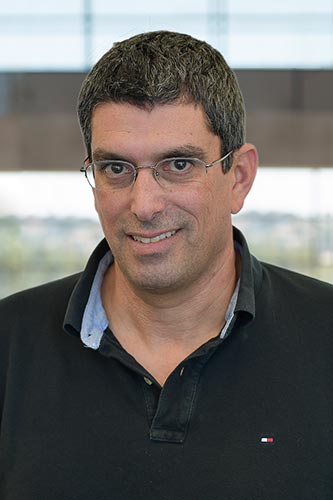
Ehud Zohary

Professor

Phone: +972-2-6586737
Fax: +972-2-6584985
Lab Phone: +972-2-6585152
Address: The Edmond and Lily Safra Center for Brain Sciences,
The Suzanne and Charles Goodman Brain Sciences Building,
Level 2, Room 2201, Edmond J. Safra Campus,
The Hebrew University of Jerusalem, 9190401
Dr. G. Levi de Veali Chair in Neurobiology
The Swiss Friends Vision Laboratory, Linking Perception, Memory and Action

Welcome to Ehud Zohary’s Lab.

Our research is focused on how the brain generates a representation of the world around us, combining incoming perceptual information with memory-based expectations, to act on it.  To appreciate this, press the following link.

Current research in our lab is centered on two main aspects characterizing the visual scene analysis:

  1. Development: Vision following recovery from prolonged blindness;
  2. Hierarchical analysis and its implementation in the human brain:

We use a variety of techniques including psychophysical testing, eye tracking methods, functional MRI, and modelling using DNNs (deep neural networks) to study these issues.

Focus #1 Vision recovery:

We study a world unique population of children in Ethiopia that have been blind from birth due to bilateral cataracts and regain eyesight only years later.

These children are found, diagnosed and receive medical treatment (i.e. surgery) by our team. But regaining eyesight is far from ensuring functional vision. The seminal studies of Hubel & Wiesel suggested that there is a “critical period” for normal vision development in the early years, after which opportunities for beneficial plastic changes in the brain are drastically limited. Thus, following their legacy, cataract surgery is typically done as early as possible, within months from birth. Our project is exceptional in having the opportunity to assess vision restoration after the presumed “critical period”, when most people would assume that permanent damage was already done.

We have been testing the recovery of visual function in this population of kids in the last 10 years. We study both simple (low-level) capabilities which may limit perception such as visual acuity, contrast sensitivity, motion perception, etc, as well as high level functions such as gaze understanding, social interaction understanding, face and body posture information extraction, and pattern completion (in slit-viewing conditions).

For full information please see our website: https://www.project-eyeopener.org/   

Focus #2: Studying the brain mechanisms that enable object and scene understanding   

How is the specific computational problem solved and what should be the specific characteristics of brain areas in the visual cortex, that match these predictions. See two examples below:

One particularly impressive capability of the visual system is our ability to identify the shape of an object moving through a narrow slit (termed anorthoscopic vision).  In this case, the global shape can only be recovered by integration of information across the seqence of partial views.  Using fMRI and multivoxel pattern analysis, we searched for brain regions that encode temporally integrated shape identity. We further required that the representation of shape should be invariant to changes in the slit orientation. We (Orlov & Zohary 2018) found strong evidence for a global encoding of shape in high-order lateral occipital cortex (LOC), but not in earlier processing stages. The slit-invariant representation of the various shapes in LOC also mirrored the structure of shape perceptual space as assessed by perceptual similarity judgment tests.

Another example is the interpretation of social scenes. Surprisingly, vision-based social scene understanding is ill-studied from both computational and neuroscience perspectives. We postulate that social scene understanding requires a series of processing steps, in a hierarchy of levels of representation, such that (1) lower-level brain regions encode social interaction primitives at the level of the individual agent (e.g. body posture, gestures, etc.); and (2) each type of social interaction is uniquely characterized by a pattern of these primitives (obtained across all interacting agents), encoded in downstream regions.

Meirav_Givon
Meirav Givon
Lab Technician
Elham_Taha_Israel
Elham Taha
Post Doc
ELSC-Baruch-Haimson
Baruch Haimson
Post Doc
IMG_1394
Benne Praegel
Post Doc
Amihai
Amichai Lavi-Rudel
PhD Student
adria dym
Adria Dym
PhD student
Hadar_Sagi_ELSC
Hadar Sagi
PhD Student
Tamar Preminger
Tamar Preminger
PhD Student
Yair Leibowitz
Yair Leibowitz
Undergraduate Student
ADMIN PHOTO
Noam Ashkenazi
Undergraduate Student
ADMIN PHOTO
Shahar Paltiel
Undergraduate Student
IMG-20250819-WA0106
Naftali Leibovitz
Undergraduate Student
ELSC-Seminars-General
Ami Shalev
ELSC-Faculty-Yoav-Adam
Yoav Adam
ELSC-Seminars-General
Yoav Livneh
ELSC-Seminars-General
Yael Shlomai
ELSC-Seminars-General
Ido Maor
ELSC-Seminars-General
Amit Vinograd
ELSC-Seminars-General
Ronen Eavry
ELSC-Seminars-General
Lior Cohen
ELSC-Seminars-General
Hadas Lapid
ELSC-Seminars-General
Yishai Elyada
ELSC-Seminars-General
Elena Kudryavitslaya
omrigilday2
Omri Gilday
Claudia_Maggi
Claudia Maggi
ELSC-Seminars-General
Hagit Kopel
ELSC-Seminars-General
Rachel Nissim
Ariel Gilad
Ariel Gilad
Genichi_Tasaka_photo
Gen-ichi Tasaka
ELSC-Seminars-General
Gideon Rothschild
ELSC-Seminars-General
Maya Groysman PhD
ELSC-Seminars-General
Natan Gold
ELSC-Seminars-General
Talia Singer
Tohar Sion Yarden 001
Tohar Sion Yarden
Libi_Feigin
Libi Feigin
Haran_Shani_2
Haran Shani Narkiss
ELSC-Seminars-General
Itamar Landau
Shachar_Moskovich
Shachar Moskovich
ELSC-Seminars-General
Gilead Raday
Or_Yudco
Or Yudco
Avaro, V., Taha, E., Shapira, S., Kuehn, G., Hummel, T., Mizrahi, A., Calegari F.

bioRxiv (2025)

Haimson, B., Preminger, T., Rayi, P.R., Sagi, H., Binshtok, A. and Mizrahi, A

bioRxiv (2025)

Praegel B, Chen F, Dym A, Lavi-Rudel A, Druckmann S and Mizrahi A.

eLife  (2025)

Haimson B, Mizrahi A.

Trends in Neurosciences. (2025)

Haimson, B., Gilday, O.D., Lavi-Rudel, A., Sagi, H., Lottem, E., Mizrahi, A.

Sci Adv. (2024)

Licht T, Yunerman M, Maor I, Lawabny N, Oz Rokach R, Shiff I, Mizrahi A, Rokni D.

Curr Biol. (2023)

Shani-Narkiss H., Beniaguev D., Segev I., Mizrahi A.

Frontiers in Neural Circuits (2023)

Haimson B, Mizrahi A.

Hear Res. (2023)

Gilday D. O., Praegel B., Maor I., Cohen T., Nelken I., Mizrahi A.

PLoS Computational Biology (2023)

Gilday D. O., Mizrahi A.

Journal of Neuroscience (2023)

Tasaka G., Maggi C., Taha E., Mizrahi A.

Journal of Comparative Neurology (2023)

Yarden. T., Mizrahi. A., Nelken I.

Journal of Neuroscience. (2022)

Yatziv S., Yudco O., Vaso K., Mizrahi. A., Devor M.

J Neurosci Res. (2021)

Feigin L., Tasaka G., Maor I., Mizrahi. A.

Society for Neuroscience, Journal of Neuroscience. (2021)

Cohen-Kashi M., Tsivourakis E., Kushinsky D., Apelblat D., Shtiglitz S., Zohar E. Sokoletsky M., Tasaka G., Mizrahi A., Lampl I., Spiegel I.

Neuron (2021)

Kudryavitskaya E., Marom E., Pash D., Mizrahi. A.

Current Biology (2021)

Clayton K.K., Williamson R.S., Watanabe Y., Hancock K.E., Tasaka G., Mizrahi A., Hackett T., Polley D.B.

Current Biology. (2021)

Shani Narkiss H., Vingrad A., Landau I.D., Tasaka G., Yayun N., Terlestky S., Groysman M., Maor I., Sompolinsky H., and Mizrahi. A

Nature Communications (2020)

Gilad A., Maor I. Mizrahi. A.

eLife (2020)

Mizrahi A. Vinograd A.

Elsevier (2020)

Tasaka G., Feigin L., Maor I., Groysman M., Denardo L., Schiavo J., Froemke R., Luo L., Mizrahi A.

Neuron.  (2020)

Dudai D., Yayon N., Lerner V., Tasaka G., Deitcher Y., Niederhoffe N., Mizrahi A., Soreq H., London M.

PLoS Biology (2020)

Maor, I., Ziv, R., Feigin, L., Elyada Y., Sompolinski H., Mizrahi A.

Frontiers in Neural Circuits  (2020)

Dudai A, Yayon N, Lerner V, Tasaka Gi, Deitcher Y, et al.

PLoS Biology (2020)

Kudryavitskaya E., Marom E., Pash D., and Mizrahi A.

Current Biology (2020)

Clayton K.K., Williamson R.S., Watanabe Y., Hancock K.E., Tasaka G., Mizrahi A., Hackett T.,Polley D.B.

Current Biology (2020)

Vinograd.A., Tasaka G., Kreines L., Weiss Y., Mizrahi. A .

Frontiers in Neuroanatomy (2019)

Witkowski E.D., Gao Y., Gavsyuk A.F., Maor I., Dewalt G.J., Eldred W.D., Mizrahi A., Davison I.G.

Frontiers in Cellular Neuroscience (2019)

Atlan G. Terem A. Peretz-Rivlin N., Sehrawat, K. Gonzales, B., Goll Y., Pozner G., Tasaka G., Goll Y., Rafaeli R., Zviran O., Lim B., Groysman M., Goshen I, Mizrahi A., Nelken I., Citri A.

Current Biology (2018)

Tasaka, G-ichi, Guenthner CJ, Shalev A, Gilday O, Luo L, Mizrahi A.

Nat Commun (2018)

Mizrahi A.

Trends in Neurosciences  (2018)

Tasaka, G. I., Guenthner, C. J., Shalev, A., Gilday, O., Luo, L., & Mizrahi, A.

Nat Commun 9, 871 (2018)

Reshef R, Kudryavitskaya E, Shani-Narkiss H, Isaacson B. Rimmerman N, Mizrahi A., And Yirmiya R.

eLife (2017)

Vinograd.A, Livneh.Y, Mizrahi A.

Journal of Neuroscience (2017)

Vinograd A, Shlomai Y., Stern M., Mukherjee D., Gao Y., Citri A., Davison I., Mizrahi A.

Cell Reports (2017)

Elyada Y., Mizrahi A.

Current Opinion in Neurobiology (2015)

Rothschild G, Mizrahi A.

Annu Rev Neurosci. (2015)

Cohen L., Mizrahi A.

Journal of Neuroscience 35.4 : 1806-1815 (2015)

Adam Y., Livneh Y., Miyamichi K, Groysman M., Luo L., Mizrahi A.

Frontiers in Neural Circuits (2014)

Livneh Y., Adam Y. Mizrahi A.

Neuron (2014)

Mizrahi A., Shalev A. Nelken I.

Current Opinion in Neurobiology (2014)

Miyamichi K, Shlomai-Fuchs Y, Shu M, Weissbourd BC, Luo L, Mizrahi A.

Neuron (2013)

Rothschild G, Cohen L, Mizrahi A, Nelken I.

J Neurosci.  (2013)

Cohen L, Koffman N, Meiri H, Yarom Y, Lampl I, Mizrahi A.

Proc Natl Acad Sci U S A, (2013)

Eban E., Rothschild G., Mizrahi A., Nelken I., Elidan G.

Artificial Intelligence and Statistics  (2013)

Kopel H, Schechtman E, Groysman M, Mizrahi A.

J Neurosci. (2012)

Livneh, Y, Mizrahi A.

Nature Neuroscience (2011)

Cohen, L, Rothschild G, Mizrahi A.

Neuron (2011)

Livneh, Y, Mizrahi A.

The Journal of Comparative Neurology, Volume 519, Issue 11, Pages 2212-2224 (2011)

Livneh, Y, Mizrahi A.

Frontiers in systems neuroscience, 3:17 (2010)

Rothschild G, Nelken I, Mizrahi A.

Nat Neurosci. 2010 Mar;13(3):353-60. (2010)

Adam, Y, Mizrahi A.

Current Opinion in Neurobiology, Volume 20, Issue 1, Pages 134-140 (2010)

Licht, T, Eavri R, Goshen I, Shlomai Y, Mizrahi A, Keshet E.

Development, 137: 261-271 (2010)

Livneh, Y, Feinstein N, Klein M, Mizrahi A.

Journal of Neuroscience, 29 (1) 86-97 (2009)

Kopel, H, Meshulam M, Mizrahi A.

Journal of Neuroscience Methods, Volume 182, Issue 2, Pages 189-194 (2009)

Currently no openings available.

Further details:
For more information, please contact: Adi Mizrahi: mizrahi.adi@mail.huji.ac.il
Honors:
Eric Roland Professor in Brain Sciences

Adi Mizrahi

Professor

Phone: +972-2-6585163
Lab Phone: +972-2-6585163
Office Phone: +972-2-6586460
Address: The Edmond and Lily Safra Center for Brain Sciences
The Suzanne and Charles Goodman Brain Sciences Building,
Level 2, Room 1204, Edmond J. Safra Campus,
The Hebrew University of Jerusalem, 9190401

“Working memory”