This study challenges two longstanding paradigms in systems neuroscience regarding interactions among the cortex, the basal ganglia, and the thalamic nuclei. First, since the 1970s, the basal ganglia have been thought to influence behavior mainly by inhibiting thalamic activity. We demonstrate that, at least during natural sleep, the basal ganglia do not simply drive their thalamic targets but instead modulate thalamic activity. Second, it has been widely proposed that thalamic burst firing during non-REM (NREM) sleep fails to wake the cortex because the bursts are periodic and highly synchronized, effectively carrying a “null” message. In contrast, our recordings during natural sleep reveal that NREM thalamic bursts (figure-spikes) are neither periodic nor tightly synchronized. Rather than intrinsic burst synchrony preventing arousal, we show that state-dependent thalamocortical dynamics—specifically cortical delta and spindle activity aligned to thalamic bursts—are sufficient to explain why these bursts do not awaken the cortex. Together, our findings suggest that during sleep, the basal ganglia modulate thalamic activity and that sleep stability is maintained by coordinated thalamocortical network dynamics rather than by periodic synchrony of thalamic bursting.
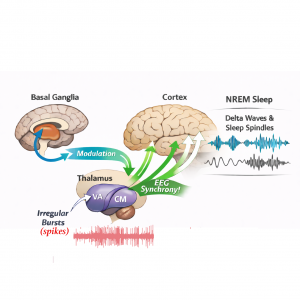
The figure (generated with assistance from ChatGPT) illustrates a simplified view of the interactions between the involved brain structures (generated by conversations with help from ChatGPT by OpenAI)