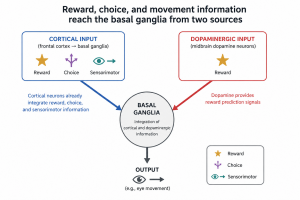
The brain’s basal ganglia help select actions and learn from rewards. Traditionally, scientists believed that reward information reached the basal ganglia mainly through dopamine-producing neurons. Using optogenetics, the researchers identified specific frontal cortical neurons that project to the basal ganglia. These neurons integrated information about expected reward, eye movements, and choice even before the signals reached the basal ganglia. These findings suggest that the basal ganglia do not rely on dopamine alone for reward processing but instead integrate reward information arriving simultaneously from both cortical and dopaminergic pathways.
Illustration