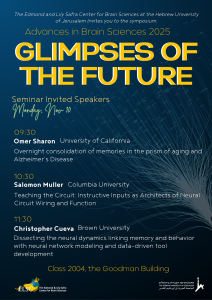
09:30 – Omer Sharon, UC Berkeley,
10:30 – Salomon Muller , Columbia University
11:30 – Christopher Cueva, Brown University
09:30
Omer Sharon, University of California, Berkeley
Overnight consolidation of memories in the prism of aging and Alzheimer’s Disease
Why must the human brain sleep? Lifespan changes in sleep and cognition provide ample variability to study the neural processes that take over when we fall asleep and tune down the sensory environment. I will describe my work on traveling slow waves during NREM sleep using in-vivo Alzheimer’s Disease pathology measurements in unimpaired older humans and across the Alzheimer’s Disease spectrum. I will argue that these findings suggest that global, whole-brain traveling waves are a key mechanism for system-level memory consolidation. Next, I will describe our work studying REM sleep during aging and how it offers a path to further uncover REM sleep function. Last, I will share unpublished data acquired using a novel method that enables whole-night EEG-fMRI across the lifespan. This powerful technique will uncover whole-brain dynamics during sleep and how they serve overnight changes in cognition, memory, and well-being.
10:30
Salomon Muller , Columbia University
Teaching the Circuit: Instructive Inputs as Architects of Neural Circuit Wiring and Function
A recurring motif across the cerebellum, hippocampus, and other brain regions is the presence of instructive inputs that generate complex spikes or plateau potentials to guide learning. In my talk I will highlight the role of these instructive inputs not only in driving learning, but also in orchestrating circuit wiring and serving as a centrepiece that reveals the circuit’s overall function. To this end I will present work in two cerebellum-like structures: the mammalian dorsal cochlear nucleus (DCN) and the electrosensory lobe of the electric fish (ELL). I will describe our recent findings revealing a novel function for the DCN in attenuating the acoustic edges of predicted sounds and present a comprehensive model of the ELL in cancelling self-generated sensory input integrating connectomics, electrophysiology, biophysics and computational modeling. Finally, I will also show recent work on how the instructive signals of the cerebellum, the inferior olive, solve the structural credit assignment problem by driving an activity-dependent developmental wiring of the Purkinje cells axons.
11:30
Christopher Cueva, Brown University
Dissecting the neural dynamics linking memory and behavior with neural network modeling and data-driven tool development
Our brains are capable of feats of learning and adaptive computation unrivaled by artificial systems. These intelligent behaviors are guided by interactions between many systems, such as, different sensory systems, memory systems, and motor systems. If we want to gain a deeper understanding of complex behaviors, and of natural intelligence more generally, we need to build models that combine the functional capabilities of these individual systems. In this talk, I will highlight some of my work towards this goal, through the study of behavior, neural activity, and neural network modeling.
In particular, I will highlight problems that arise when we consider how our memory systems receive and store visual information from the world. The solutions to these problems reveal new strategies for “hiding” information in biological and artificial neural networks, and suggest a new role for intermediate visual areas in this computation.