Skill acquisition
Perception, memory, and reasoning have traditionally been studied separately. I am interested in the relations between these mental operations and in the dynamics of these relations as people practice and become experts. I am further interested in deciphering which mechanisms malfunction in the cases where practice does not lead to expertise, like the case of reading disability (dyslexia) in spite of huge amount of practice.
Conceptual frameworks for learning
1.Top-down: task driven learning
The Reverse Hierarchy Theory of perception and learning, which explains learning processes as a top-down driven processes, which proceeds backwards – and task-induced learning processes that begin at the “top” of the hierarchies and proceed by a backward search for the most informative inputs (neural populations).
2.Bottom-up: Statistical Bayesian learning
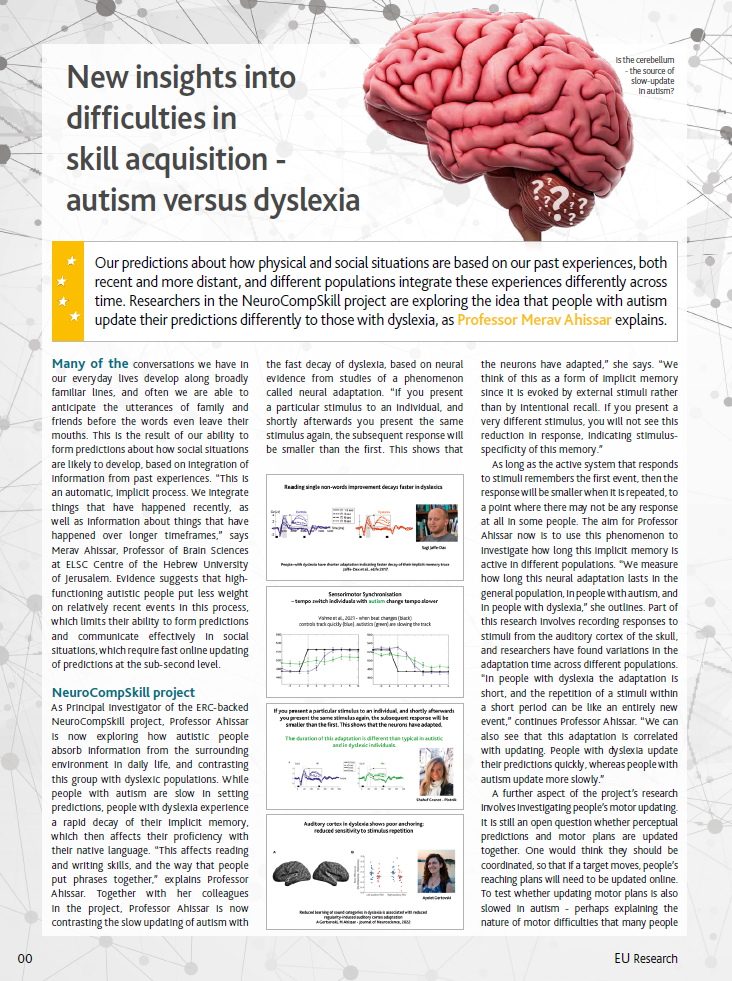
The poor-anchoring (and faster memory decay) theory of dyslexia, which explains the difficulties of dyslexics in acquiring reading expertise as a consequence of faster decay of perceptual traces, which leads to a shallower long-term learning slope, manifesting slower accumulation of linguistics (and non-linguistic) regularities.
The slow-update theory of autism, which proposes that high-functioning individuals with autism (no language difficulties) are slow in updating their perceptual predictions and their motor plans – which impedes online interactions, both social and non-social.
Techniques
We use behavioral task, and use computational models to decipher and quantify underlying mechanisms.
We use ERP to assess within-trial dynamics of task preparation, neuronal adaptation and their relation to behavior.
We use fMRI to assess cross-trial dynamics and “division of labor” between various cortical and sub-cortical regions.
Recent Highlights
Funding & Research Projects:
A. ERC – ADVANCED – NEUROCOMPSKILL
Understanding the failure of acquiring reading and social expertise (dyslexia and autism) within a unified framework of skill acquisition
Why do most people acquire expertise with practice whereas others fail to master the same tasks? NeuroCompSkill offers a neuro-computational framework that explains failure in acquiring verbal and non-verbal communication skills. It focuses on individual ability in using task-relevant regularities, postulating that efficient use of such regularities is crucial for acquiring expertise. Specifically, it proposes that using stable temporal regularities, acquired across long time windows (> 3 sec to days) is crucial for the formation of linguistic (phonological, morphological and orthographic) skills. In contrast, fast updating of recent events (within ~ .3- 3 sec), is crucial for the formation of predictions in interactive, social communication. Based on this, we propose that individuals with difficulties in retaining regularities will have difficulties in verbal communication, whereas individuals with difficulties in fast updating will have difficulties in social non-verbal communications
B. ISF
Perceptual learning: the role of learning stimulus statistics
Practice based improvement is a main characteristic of human behavior. This applies even to basic perceptual processes. But what is it that improves? Is it the accuracy of our sensory representations, or the validity of our implicit predictions? Since perception is an integrative process, which implicitly merges information from incoming stimuli with experience-based knowledge of the world, improvement can stem from either, or both. Recent conceptual developments, such as introduction of Bayesian framework to cognitive neuroscience, offer new tools and insights for addressing this question. The Bayesian framework views perception as the posterior outcome of integrating (multiplying) the sensory response (likelihood) with knowledge about statistics of stimuli in the world (prior), allowing quantitative estimates of the contribution of each component to the resulting perceptual performance. However, the Bayesian framework does not specify how the prior is learned. We now aim to study the dynamics of learning the prior, which is not initially available to the performer, and may itself change. Here we use the term – “prediction”, referring to participants’ “belief” regarding the statistics of stimuli in the world. We shall characterize these predictions as a function of the trained conditions, at the behavioral and neural levels, in three different populations: general adult population, adult dyslexics and children, whose pattern of forming predictions is expected to differ.